Certified Infection Control and Bio-hazard Training For ECEC
Mandatory 2026 Compliance Update: If your workplace contains biological hazards, the Safe Work Biohazard Code 2026 strictly dictates that all employees must receive formal, certified training.
Early Childhood services have been explicitly designated as a primary focus under this framework because your teams manage high-frequency, complex biological exposures from infectious disease outbreaks to daily body fluid management in a compressed workplace environment. This explicit regulatory focus means standard workplace hygiene checklists are no longer enough. WHS inspectors are now auditing ECEC services with a direct mandate to verify that every educator on the floor possesses formal, certified competency in bio-hazard mitigation.
Historically, many ECEC centres have viewed codes of practice or industry frameworks as optional guidelines. This is a critical regulatory misunderstanding.
While a Code of Practice itself is not a standalone piece of legislation, it serves as the legally recognized benchmark for what is "reasonably practicable" to eliminate or minimise risk. Under Australian law, when Safe Work Australia introduces the Model Code of Practice: Managing risks of biological hazards at work (2026), it automatically triggers your mandatory legislative duties under WHS Regulation 39 (Provision of information, training and instruction) and Section 19 of the WHS Act.
If you do not meet or exceed the standard set in the 2026 Code, you are automatically in breach of the enforceable WHS Regulations.
The Enforced Codes & Increased Compliance Requirements:
To satisfy WHS inspectors under this framework, your compliance trail must now account for these specific codes and stricter benchmarks:
WHS Regulation 39 (The Training Mandate): You must prove that training is not just a casual verbal overview. It must be suitable, adequate, and directly relevant to the specific nature of biological risks in ECEC.
Verification of Competency (VoC): Relying on a "signed policy document" on a shelf is no longer legally defensible. Compliance now requires objective, verifiable proof such as completed assessment metrics or quizzes demonstrating that each individual educator understands biohazard mitigation.
The 2026 Shift from "Hygiene" to "Risk Mitigation": Standard cleaning checklists are insufficient. The code demands formal training in specific exposure controls, clean vs. contaminated zone discipline, and explicit escalation thresholds for infectious outbreaks and body fluid incidents.
Start with the free training
Free 1-hour Infection Control & Biohazard Training for ECEC leaders
Understanding The 2026 Requirements is a great place to start
Lindsay Smith Standards Author | Infection Control Specialist | ECEC Sector Advocate
Lindsay Smith is the architect of the National Child Care System (NCCS) a system-level industry reform package designed to integrate operational workforces into the Early Childhood Education and Care sector as recognised, regulated, and professionalised roles. Cleaning is the first operational workforce the NCCS is ready to deliver, underpinned by the Childcare Cleaning Standard (CCS), Australia's first childcare-specific cleaning governance framework also authored by Lindsay.
She holds formal competency in CPPCLO3006 (Apply infection prevention and control procedures to own work activities) and HLTINF006 (Apply basic principles and practices of infection prevention and control), supported by over 15 years of hands-on experience in the commercial cleaning industry and five peer-reviewed, DOI-registered research publications on infection control, biohazard risk, and workforce governance in ECEC with her foundational paper ranking in the top 5% of research outputs on Zenodo.
Lindsay's training is grounded in operational reality and benchmarked against the National Quality Framework, WHS legislation, and the Safe Work Australia Biological Hazards Code of Practice.
Move beyond simple pass/fail metrics. Our assessment suite utilizes a high-standard Competency-Based Assessment (CBA) model, delivering the "audit-ready evidence" required by ACECQA and WHS regulators

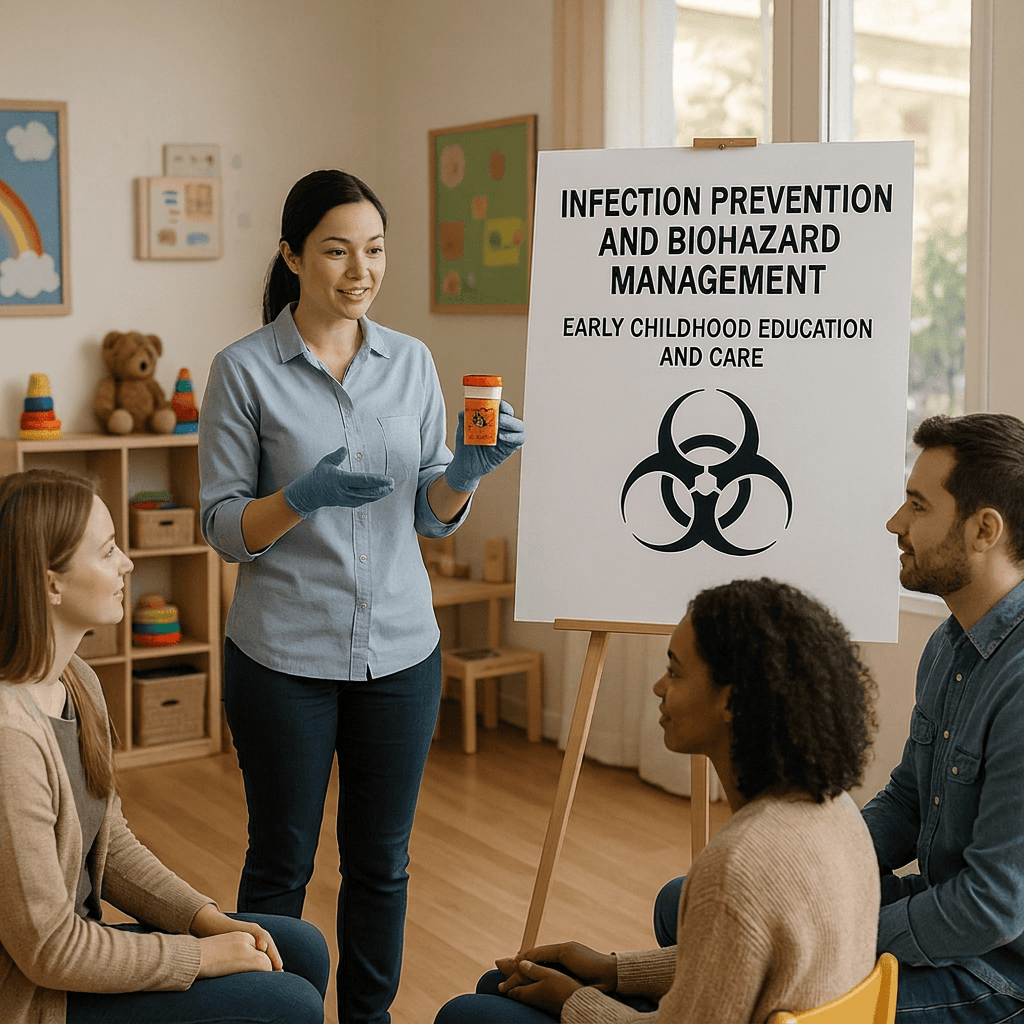
24/7 Digital Access: Educators can chip away at the 15 bite-sized modules during programming blocks, quiet times, or entirely at their own pace over 12 months.
Built-in Compliance Tracking: Features mandatory verification quizzes and automated progress monitoring, giving management an instant auditable paper trail.
Immediate Commencement: Register your staff and have them start training today
This course gives leaders the clarity they’ve been asking for grounded in legislation, aligned with regulators, and built for real‑world operations in 2026
Who This Course Is For
This training is designed specifically for:
• Directors
• Approved Providers
• Nominated Supervisors
• Compliance & Governance Leads
If you need clear, defensible guidance on WHS obligations, this course is for you.
Immediate Commencement: Register gain instant access to Course
Ideal for bringing your entire team up to speed simultaneously and building a unified compliance culture.
Fast-Tracked 3-Hour Intensive: Get your whole centre certified in a single, high-impact session without disrupting daily operations.
Flexible Scheduling: After-hours and weekend slots are available to match your staff meeting or professional development days.
Fully Catered & Resource-Packed: Lunch or dinner is included in your booking price,
Unlimited Staff Enrolments: This model removes the "per-seat" pricing barrier, allowing you to enrol every staff member
Secure Compliance Portal: with dedicated self-serve manager access. Enrol staff into training tracks instantly and monitor real-time progress
Complete SSOW & Workbook Library: Instant access to our full library of Safe Systems of Work (SSOW) and Cleaning Management Workbook templates.
Managers Community Hub: Join a dedicated space for ECEC leaders focused on audit and rating support. Access exclusive resources and peer insights
Dedicated Implementation Manager: we provide the human support needed to embed these systems into your centre’s operations.
A: Staying Healthy provides excellent daily operational steps, but it is not a piece of WHS legislation. The WHS Act (Section 19) requires you to provide adequate training and instruction to manage workplace biological risks. This course takes those operational steps and wraps them in a legally compliant WHS framework, giving you the signed training registers you need for an audit.
A: WHS law states training must be adequate for the risks at the current time. With the introduction of the new national Code of Practice, your existing training is likely outdated. Providing this refresher ensures your team is compliant with the newest national benchmarks.
A: Under Australian WHS laws, failure to provide adequate training and maintain proper training records is a breach of WHS Regulation 39. If a WHS inspector visits during a routine audit or following an infectious outbreak (like gastro or hand-foot-and-mouth) and finds your team does not have documented, up-to-date competency in biological hazard management, your centre can face formal Improvement Notices, on-the-spot fines, or severe non-compliance penalties.
A: Not at all—it bridges the gap between them. Staying Healthy in Childcare provides excellent clinical hygiene steps for working with children, but it is not a legal WHS framework. Our training takes those operational steps and aligns them with the mandatory legal benchmarks set out in Safe Work Australia's Model Code of Practice: Managing the risks of biological hazards at work. We provide the WHS verification that protects your business from liability.
A: While casual chats are great for reminders, they rarely satisfy WHS inspectors when managing high-risk biological hazards. Legally, training must be suitable, adequate, and verifiable. Our course features built-in verification quizzes and assignments for every module. This creates an unshakeable, auditable paper trail proving each educator has been formally assessed and deemed competent.
A: Yes! Because our course directly improves educators' operational skills, health protection, and regulatory knowledge, it counts perfectly toward your team's ongoing professional development and quality improvement planning (QIP) goals under the National Quality Framework (NQF).
A: We know how hectic childcare schedules are with room ratios and staff programming time. The online self-paced option gives your staff 12 months of 24/7 access. They can chip away at the 15 bite-sized modules during programming blocks, quiet times, or staff meetings entirely at their own pace.